naturasounds
H2O unweighted water tuning fork 429.62 Hz | A4 Therapeutic Water
H2O unweighted water tuning fork 429.62 Hz | A4 Therapeutic Water
Couldn't load pickup availability
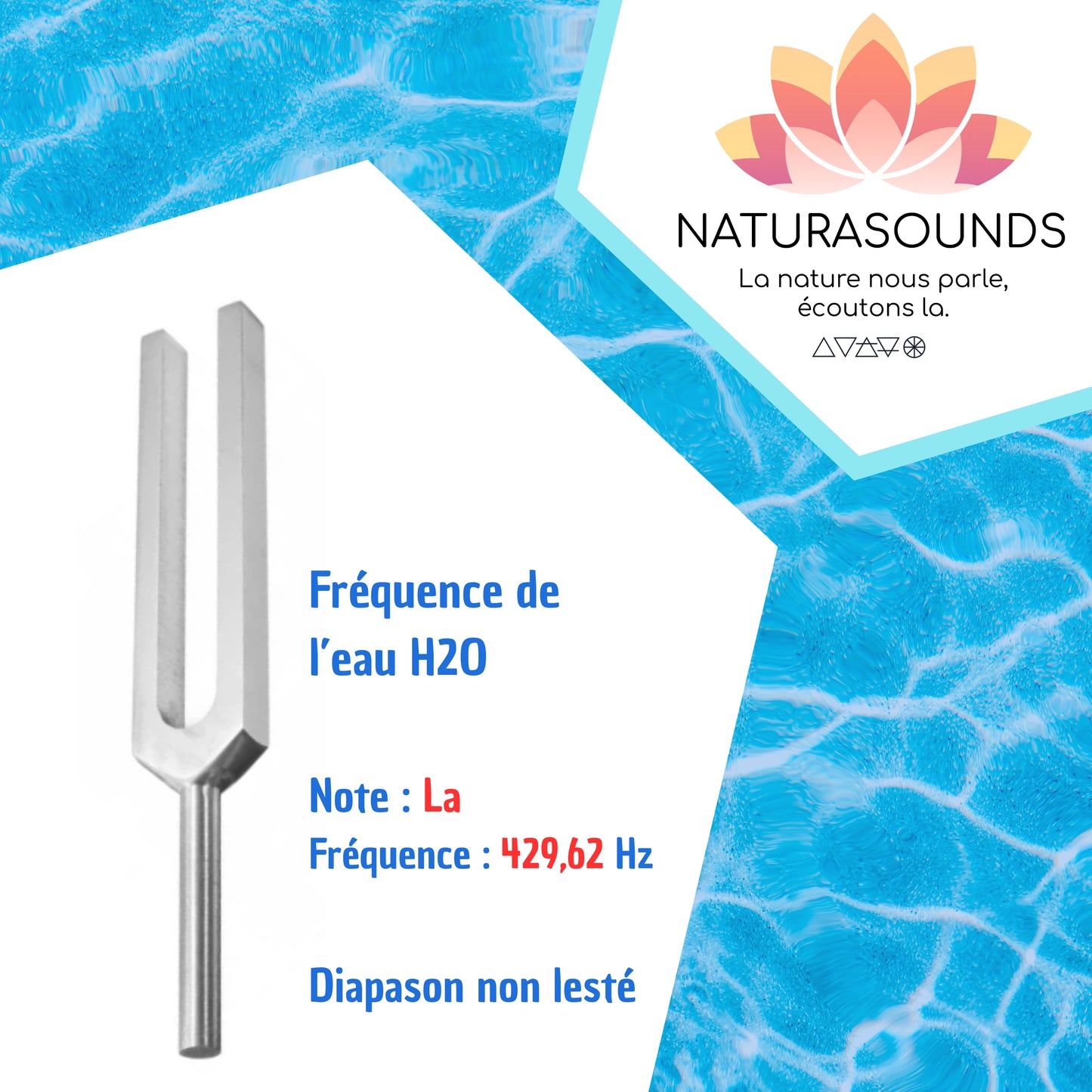
This unweighted tuning fork is calibrated to 429.62 Hz, the molecular resonance frequency of water (H2O), calculated from its molar mass via the Einstein-Planck equation. Unlike our weighted version (107.40 Hz, for deep body vibrations), this unweighted model is designed for musical use and more subtle vibrational work. This discovery stemmed from the work of Renaud Ruhlmann and his research on 432 Hz, as well as his meeting with Prof. Marc Henry. They co-refined this frequency in late 2019, and Renaud Ruhlmann was the first to use it in his "sonic herbalism" practice starting in April 2020. All these references can be found in his book "La mélodie secrète des végétaux" [The Secret Melody of Plants], which Prof. Marc Henry prefaced. Renaud Ruhlmann is a pioneer in this research into "sonic molecular chemistry" and enabled Prof. Marc Henry to change the frequency of water that he had calculated in 2015 for his book "Musique et physique quantique" [Music and Quantum Physics] to 54 Hz.
See also: the weighted H2O 107.40 Hz tuning fork →
Where does the 429.62 Hz frequency come from?
This frequency is the second octave of the fundamental frequency of water (107.40 Hz). It corresponds to an A4, very close to the 432 Hz used by many musicians and therapists, but derived from a different calculation:
- Molar mass of water: 18.015268 g/mol
- Native frequency calculated: 4.057656 × 10²⁴ Hz
- Transposition of 73 octaves into the audible range: 429.62 Hz
Note: The difference from the classic 432 Hz is only 2.38 Hz—almost imperceptible to the ear, but it reflects a different calculation origin (molecular mass of water rather than musical convention).
Weighted or unweighted tuning fork: which one to choose?
| Unweighted (429.62 Hz) | Weighted (107.40 Hz) | |
|---|---|---|
| Main use | Musical, tuning, subtle vibration | Deep body vibration |
| Resonance duration | 25-30 seconds | 15-20 seconds |
| Ideal for | Musicians, sound therapy practitioners | Direct application on the body |
Technical specifications
| Characteristic | Detail |
|---|---|
| Frequency | 429.62 Hz (laboratory precision) |
| Musical note | A4 (close to A 432 Hz) |
| Type | Unweighted |
| Material | Medical-grade aluminum alloy |
| Resonance | 20-25 seconds after activation |
| Supplied with | Blue velvet protective pouch |
How to use it
- Activation: Gently strike the prongs against a soft surface (knee, palm).
- Listening or application: Bring it close to the ear for musical use, or hold it a few centimeters from the body for sound therapy.
- Duration: Let it resonate naturally, without forcing the duration of the session.
What science says (and what it doesn't say yet)
Established:
- Frequency calculation by the Einstein-Planck equation is mathematically valid.
- The human body is composed of approximately 70% water.
- Mechanical vibrations have a demonstrated physiological effect (use in physiotherapy).
Not proven to date:
- A specific effect of this frequency on cellular hydration, detoxification, or muscle recovery has not been the subject of a published clinical trial.
- We present this tool as a practice for wellness and relaxation, not as a treatment.
Frequently asked questions
What is the difference from a classic musical tuning fork?
This tuning fork is calibrated to a frequency calculated from the molecular mass of water, rather than to a standard musical reference note.
Can I use it in music? Yes, its proximity to 432 Hz makes it an interesting choice for musicians exploring alternative frequencies.
Is this a medical device? No. It is a wellness and relaxation tool that does not replace medical advice.
Partager