naturasounds
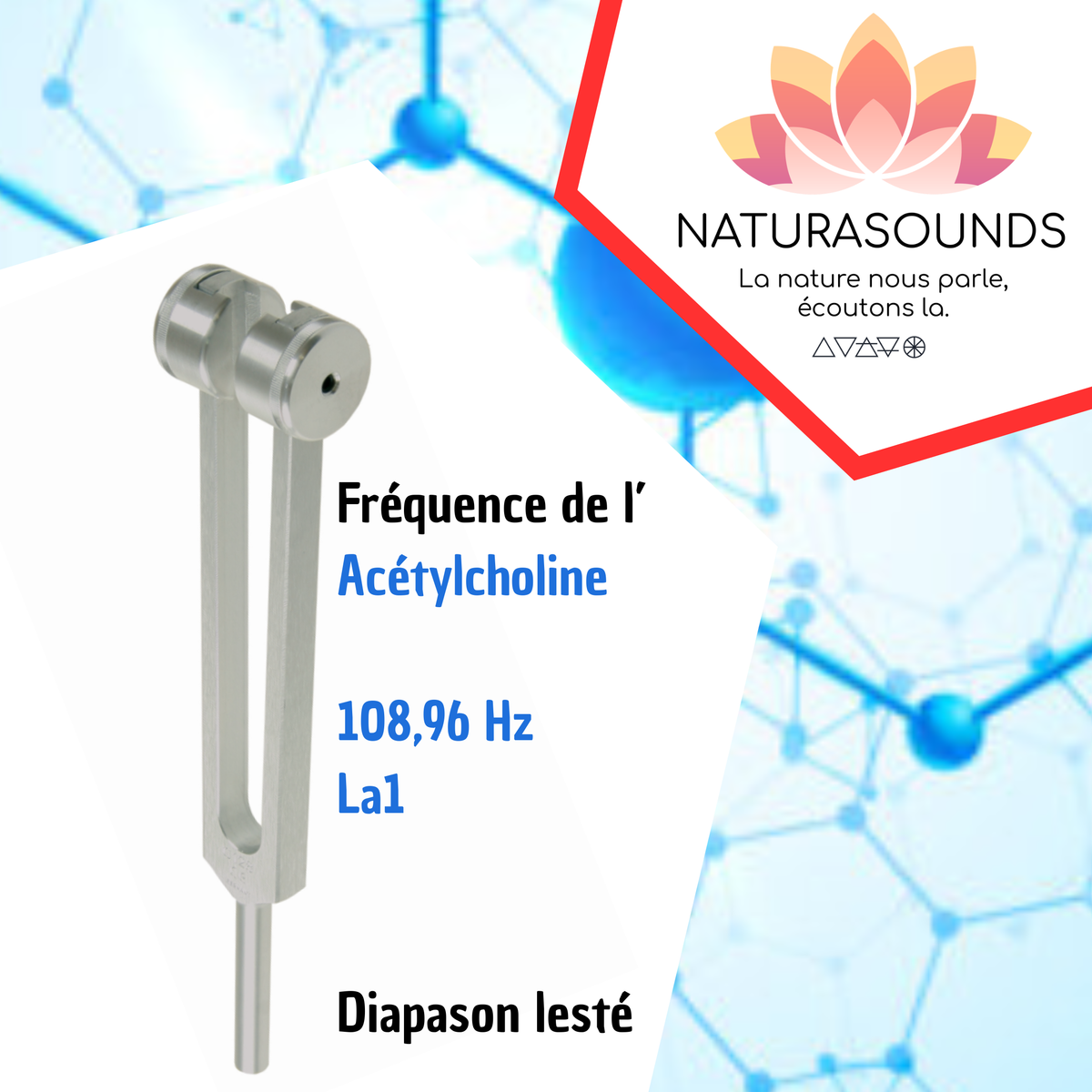
Acetylcholine Tuning Fork 108.96 Hz | Molecular Frequency
Acetylcholine Tuning Fork 108.96 Hz | Molecular Frequency
Couldn't load pickup availability
This tuning fork is tuned to 108.96 Hz, a frequency we calculate based on the molecular mass of acetylcholine, an essential neurotransmitter in the nervous system. It is part of our vibratory sound therapy approach based on the molecular signature of molecules of biological interest.
Molecular identity of acetylcholine
| Property | Value |
|---|---|
| Chemical formula | C7H16NO2+ (cation) |
| IUPAC name | 2-(trimethylazaniumyl)ethyl acetate |
| Molecular mass | 146.21 g/mol |
| Structure | Ester of choline and acetic acid |
| Biological function | Neurotransmitter of the central and peripheral nervous system |
Acetylcholine was the first neurotransmitter identified, discovered by Otto Loewi in 1921 (work awarded the Nobel Prize in 1936). It plays a documented role in neuromuscular transmission, memory and attention, and regulation of the autonomic nervous system.
Where does the 108.96 Hz frequency come from?
As with our tuning forks dedicated to water, this frequency is obtained from the molecular mass of acetylcholine (146.21 g/mol), transposed into the audible range according to our Einstein-Planck calculation method.
An important point of transparency: this method of transposing a molecular mass into a sound frequency is an approach specific to Naturasounds, inspired by real physical principles (mass-energy relation) documented since the work of Joël Sternheimer and the theory of "protéodies," which helped shed light on the interactions between molar masses and their sound frequency equivalents.
Technical specifications of the tuning fork
| Characteristic | Detail |
|---|---|
| Frequency | 108.96 Hz (± 0.1 Hz) |
| Type | Weighted tuning fork |
| Material | Medical-grade alloy |
| Resonance duration | 15-20 seconds |
| Supplied with | Protective pouch |
How to use it
- Activation: gently strike the prongs against a soft surface.
- Application: hold the tuning fork near the ear, or place its base on the sternum or temples.
- Duration: let it resonate naturally, in 5 to 10-minute sessions.
- Suggested context: moments of concentration, reading, or intellectual work, in a quiet setting.
What science says
Established:
- Acetylcholine is a real neurotransmitter, with a documented role in memory, attention, and muscle contraction.
- Frequency calculation by molecular mass transposition is mathematically reproducible.
- Sound vibrations have a demonstrated effect on general relaxation and attentional focus (classic use in sound therapy).
We present this tuning fork as a tool for concentration and well-being, to be explored for its sensory experience, not as a means to influence your brain chemistry.
For whom?
- People seeking concentration in an intellectual or study setting.
- Sound therapy practitioners curious about exploring molecular frequencies beyond water.
- Neuroscience and well-being enthusiasts interested in the link between chemistry and sound therapy.
Frequently asked questions
Why choose acetylcholine among all possible molecules? It is a central neurotransmitter in memory and attention functions, making it an interesting starting point for our exploration of molecular frequencies applied to cognitive well-being.
Is this a medical device? Yes, because all our tuning forks are medically certified by their manufacturer, Arno Barthelmes in Germany, a family business that has been creating them since 1884. It is a well-being tool that does not replace medical advice, particularly regarding any questions related to memory or cognitive functions.
Partager